%20(1).png)
%20(1).png)
8 Buildings by Mid-Century Modern Architects Palm Springs Visitors Must Photograph

Updated: Apr 15
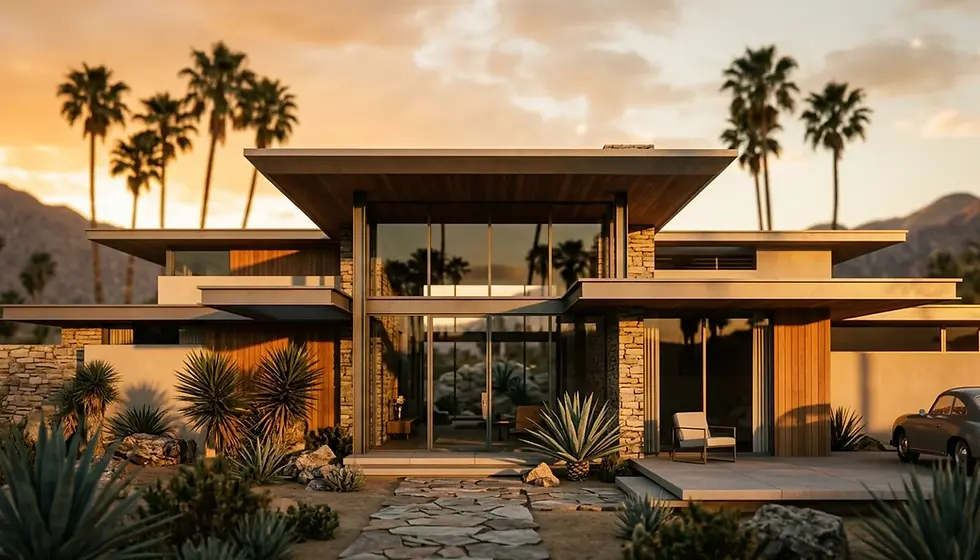
Mid-century modern architects in Palm Springs produced some of the most photographed residential and civic buildings in California between 1940 and 1975, creating an outdoor museum of clean lines, flat roofs, and glass walls set against the San Jacinto Mountains. Names like Albert Frey, Donald Wexler, E. Stewart Williams, and William Krisel transformed a small desert resort town into a living archive of modernist design. In 2026, that legacy draws a new kind of visitor: the design-literate traveler who wants to photograph these buildings, not just read about them. To learn more about what mid-century modern design means and its enduring style charm, our guide covers the movement in depth.
Palm Springs contains one of the highest concentrations of mid-century modern architecture in the United States, with landmark buildings open to public view along walkable and drivable corridors.
Key architects include Albert Frey (Tramway Gas Station, City Hall), Donald Wexler (Palm Springs International Airport, the seven steel homes), E. Stewart Williams (Palm Springs Art Museum, Twin Palms Estate), and William Krisel of Palmer & Krisel (Twin Palms subdivision).
Most buildings on this list are visible from a public right-of-way; several are private residences best photographed from the street during morning golden hour, roughly 6:30: 8:00 AM.
Modernism Week, typically held each February, offers organized tours and one-day open-house access to homes that are otherwise off-limits year-round. Read your guide to Modernism Week Palm Springs for everything you need to plan your visit.
The Taylor Suite and Bowie Suite at The Muse Hotel are located about 6 minutes from Palm Springs Art Museum Architecture and Design Center, making the property a practical base for a full day of architectural photography.
Architecture tours with Palm Springs Mod Squad run approximately 90 minutes and combine historical context with photography-friendly routing.
This guide inverts the usual approach. Most articles profile the architects and mention buildings as an afterthought. Here, each building is the hero. You get the specific address, the ideal shooting time, the best angle, and honest notes on public access. The architectural history is there too, but only as much as you need to understand why the building looks the way it does.
Palm Springs's architecture tourism industry is no accident. According to Visit Greater Palm Springs, tourism supports 1 in 4 jobs in the region, and the concentration of preserved mid-century buildings is a primary reason design travelers choose Palm Springs over other Southern California desert destinations. The buildings covered here range from civic landmarks you can walk through to private residences best appreciated from the sidewalk, and each one rewards a patient photographer who arrives at the right time of day. For more on planning a romantic getaway in Palm Springs or a girls weekend in Palm Springs around the architecture scene, our dedicated guides have you covered.

Who Were the Mid-Century Modern Architects in Palm Springs?
Mid-century modern architects in Palm Springs refers to the group of designers who built the city's residential neighborhoods, hotels, and civic structures roughly between 1940 and 1975, a movement locally called Desert Modernism. Specifically, this school adapted the European International Style to the Coachella Valley's climate: deep overhangs for shade, glass walls oriented toward mountain views, flat or butterfly roofs to collect rainwater, and materials like poured concrete, redwood, and steel that aged well in the dry heat.
The five figures whose work appears most frequently on photography itineraries are:
Albert Frey (1903: 1998): Born in Zurich, trained in Le Corbusier's Paris office on projects including Villa Savoye. He moved to Palm Springs in 1934 and never left, eventually being buried at Welwood Murray Cemetery. His personal home, Frey House II, and the Tramway Gas Station are the two buildings most associated with his name.
Donald Wexler (1926: 2015): Born in South Dakota, trained at the University of Minnesota, worked under Richard Neutra in Los Angeles before relocating to Palm Springs in 1952 to work with William Cody. His firm Wexler & Harrison designed seven all-steel homes in 1960 for the Alexander Construction Company, all of which carry Class One Historic Site designation from the City of Palm Springs.
E. Stewart Williams (1909: 2005): The only Palm Springs native on this list, Williams designed Frank Sinatra's Twin Palms estate (featuring a piano-shaped pool) and the first phase of the Palm Springs Art Museum in 1976.
William Krisel (1924: 2017): Born in Shanghai, his firm Palmer & Krisel designed more than 30,000 living units across Southern California over a 50-year career. The Twin Palms subdivision, the Alexander Construction Company's first Palm Springs development, remains the best-known example of Krisel's neighborhood-scale modernism.
William Cody (1916: 1978): Born in Dayton, Ohio, trained at USC, and relocated to Palm Springs in 1946. His Del Marcos Hotel (1947) won a creative design award from the Southern California AIA chapter and received Class 1 Historic Site designation from Palm Springs City Council on May 2, 2012.
Richard Neutra and John Lautner also produced landmark buildings in Palm Springs, though both are better associated with Los Angeles. Their contributions are covered where the individual buildings appear in the list below.

1. Tramway Gas Station (Now Tramway Visitor's Center) by Albert Frey
The Tramway Gas Station is a mid-century modern landmark designed by Albert Frey in the late 1960s, recognizable by its dramatically cantilevered "flying wedge" canopy that slices over the driveway at the northern edge of Palm Springs. The structure now operates as the Palm Springs Visitor Center, located at 2901 N Palm Canyon Drive, making it the rare Frey building that is fully open to the public at no charge.
For photographers, this is one of the easiest buildings on the list to access and the most forgiving in terms of shooting angles. The canopy reads best from the east side of the parking lot in the late afternoon, when west-facing light throws sharp angular shadows across the cantilevered soffit. Golden hour from the northwest captures the canopy against the mountain backdrop. The corrugated steel cladding picks up warm tones in low light. Avoid midday, when flat overhead light flattens the structure's geometry.
Practically speaking, you can pull into the parking lot, walk around the building, and spend 20: 30 minutes shooting without any restrictions. The visitor center interior is open daily from roughly 9 AM to 5 PM and carries free maps to other architectural landmarks in the area. If you are combining this stop with a trip to the Palm Springs Aerial Tramway, note that tram tickets sell out quickly on weekend mornings; book them before arriving at the visitor center.
The Marilyn Suite at The Muse Hotel is about 10 minutes from the Tramway Visitor's Center, making it a comfortable starting point for an early morning photography run to this building before the parking lot fills.
2. Frey House II by Albert Frey
Frey House II is Albert Frey's personal residence, completed in 1964 and built into a rocky hillside above the Palm Springs Art Museum. The house is extraordinary because Frey did not remove the boulders from the site; instead, he built around and through them, letting a massive granite rock intrude into the living space and penetrate the glass wall. He lived there until his death in 1998 at age 95.
The building is now part of the Palm Springs Art Museum Architecture and Design Center collection. Interior access is available only through organized museum tours, which run on a seasonal schedule and sell out weeks in advance during Modernism Week in February. From the street below, the house is partially visible but the hillside setting limits ground-level photography. The best exterior shot requires either hiking the trail above the museum or booking a tour that includes rooftop terrace access.
One honest caveat: if you are visiting purely for Instagram content and cannot book a tour, this building rewards architecture enthusiasts more than casual photographers. The drama is interior, not exterior. Save the tour slot for Frey House II; put the Tramway Visitor's Center on your exterior photography list instead. Our post on Palm Springs mid-century modern tours outlines seven unforgettable guided options for deeper access.
3. Del Marcos Hotel by William Cody
The Del Marcos Hotel is a 17-room modernist hotel designed by William Cody in 1947, located at 225 West Baristo Road in Palm Springs's historic Tennis Club neighborhood. Cody built it from native stone and redwood arranged around a central pool, a layout that would later define the vocabulary of Palm Springs resort design for the next two decades. It won a creative design award from the Southern California AIA chapter and received Class 1 Historic Site designation from Palm Springs City Council in 2012.
Photographically, the Del Marcos is one of the most satisfying buildings on this list because the courtyard is self-contained. The stone walls, redwood screens, and pool together create a frame-within-a-frame composition that works from multiple positions. Morning light hits the west-facing redwood screens on the Tennis Club side; late afternoon is better for the pool courtyard, when direct sun crosses the water. The street facade on Baristo Road has a low horizontal profile that shoots well with a 35mm or wider focal length.
The hotel continues to operate as a boutique property. Guests have full courtyard access; non-guests can view the exterior from Baristo Road without restriction. The Tennis Club neighborhood clusters several architectural landmarks within a short walk, making it worth building 45: 60 minutes into any architecture photography route. If you are looking for a stylish mid-century modern hotel in Palm Springs to anchor your stay, our roundup covers the top options across the city.
4. The Seven Steel Homes by Donald Wexler and Harrison
The seven steel homes are a set of all-steel prefabricated residences designed by Wexler & Harrison in 1960 for George Alexander of the Alexander Construction Company, located at the northern edge of Palm Springs near the 2100: 2200 block of North Sunflower Drive. The project was intended as a pilot program for mass-produced steel housing; rising steel costs halted construction after only seven units, making them a curio of mid-century construction history. All seven carry Class One Historic Site designation from the City of Palm Springs.
These are private residences. Photograph them from the street, keep conversations brief and courteous if residents are outside, and do not enter driveways. The homes are visually distinctive: corrugated steel panels, wide overhangs, and carports with exposed steel framing. Early morning light from the east is ideal, when long shadows emphasize the horizontal corrugation patterns. The street is quiet enough before 8 AM to shoot without vehicles blocking the sightlines.
For context on the Alexander Construction Company and their mid-century Palm Springs homes, Dwell's long-form feature covers the full scope of the Alexanders' collaboration with Wexler, Krisel, and others. It is worth reading before visiting so you can distinguish the steel homes from the more numerous timber-frame Alexander houses nearby. For more on exploring vintage Palm Springs beyond architecture, our guide covers the city's best vintage destinations.
Who Was the Famous Mid-Century Modern Architect in California?
Richard Neutra is widely considered the most internationally recognized mid-century modern architect working in California, though his Palm Springs presence is concentrated in a single building. Neutra was born in Vienna in 1892, trained under Adolf Loos, worked at Erich Mendelsohn's Berlin office, and came to California in the late 1920s. His Kaufmann House, built in Palm Springs in 1947 for department store heir Edgar Kaufmann Sr. (who had also commissioned Frank Lloyd Wright's Fallingwater), is described by architectural historians as one of Neutra's finest residential designs.
The Kaufmann House is a private residence on West Vista Chino Road. It is not open for walk-in tours. The building became internationally known through Julius Shulman's photographs, archived at the Getty Research Institute in Los Angeles, which remain the definitive visual record of the structure and of Palm Springs modernism broadly. Shulman shot the house in the late afternoon with the San Jacinto Mountains as a backdrop, a composition worth replicating: position yourself near the street facing southwest, wait for late afternoon light, and shoot wide enough to include the mountain range.
John Lautner (1911: 1994) is the other California mid-century name worth knowing for Palm Springs. His Elrod Residence features a poured-concrete "sunburst" canopy and appeared as Willard Whyte's home in the 1971 James Bond film "Diamonds Are Forever." The Elrod House is also a private residence; exterior viewing from Ladera Circle is possible. Lautner's Sheats-Goldstein residence in Los Angeles, now donated to LACMA, has an angled coffered ceiling with 750 drinking-glass skylights and appeared in "The Big Lebowski" for comparison.
5. Twin Palms Estate (Frank Sinatra House) by E. Stewart Williams
The Twin Palms Estate is a private residence at 1148 East Alejo Road designed by E. Stewart Williams in 1947 as Frank Sinatra's first Palm Springs home. The commission was Williams's first residential project. The property is most photographed for two features: the butterfly roof (a V-shaped profile that channels rainwater toward a central drain rather than to the building's edges) and the piano-shaped swimming pool, visible only from elevated angles or from inside during paid tours.
Unlike most buildings on this list, Twin Palms is available for private tours and event rentals. Public tours run on selected dates; check the current schedule before planning your visit. Tour access gives you legal entry to the grounds, direct pool photography from multiple angles, and interior access, which no exterior-only visit provides. If your goal is a portfolio-quality image of the piano pool, the tour fee is worth it.
From the street, the butterfly roof reads clearly from the east side of Alejo Road in the morning. The twin palm trees that give the property its name stand in the front yard and anchor the foreground of most street-level shots. Keep the vertical composition tight on the roofline to emphasize the V-shape against the sky. For more on experiencing vintage Palm Springs for the perfect weekend getaway, our guide covers seven unforgettable approaches.
6. Palm Springs Art Museum and Architecture and Design Center by E. Stewart Williams and Marmol Radziner
The Palm Springs Art Museum is a civic building with two distinct architectural personalities. E. Stewart Williams designed the original structure's first phase in 1976, working in a later modernist vocabulary with board-formed concrete walls and a rectilinear massing that sits low against the mountain backdrop at 101 Museum Drive. The Santa Fe Federal Savings and Loan building (1960), also by Williams, was renovated by LA-based practice Marmol Radziner and reopened in 2014 as the Palm Springs Art Museum Architecture and Design Center at 300 South Palm Canyon Drive.
For photographers, the main museum building's best angle is from Museum Drive early in the morning, when the light hits the concrete walls from the southeast and the shadow lines from the board-formed texture become visible. The building's landscaping, including mature desert plantings along the museum path, adds foreground interest that purely architectural images often lack.
The Architecture and Design Center on Palm Canyon Drive is a smaller building but more accessible for street photography. The glazed storefront and restored mid-century signage on South Palm Canyon read well from across the street with a standard 50mm equivalent lens. Check hours at the Architecture and Design Center's website before visiting, as exhibition hours vary seasonally.
Guests staying in the Taylor Suite are about 7 minutes from the Palm Springs Art Museum, a convenient distance for a morning shoot before the museum opens and foot traffic picks up on Palm Canyon Drive.

7. Palm Springs International Airport by Donald Wexler
The Palm Springs International Airport terminal, designed by Donald Wexler in 1965, is a working public building and one of the most accessible mid-century modern structures in the city. The terminal's covered walkways, thin-shell concrete canopies, and openwork concrete block screens are visible from the departures area without purchasing a ticket. Wexler also designed the Dinah Shore Residence in 1964, but the airport is the building where his institutional vocabulary is most fully expressed at a civic scale.
Photographically, the covered walkways outside the terminal produce strong geometric shadows throughout the afternoon. The concrete block screens catch raking light from early morning through mid-morning. This is the only building on the list where you can combine architecture photography with a practical purpose: if you are arriving or departing, build 20 minutes into your airport schedule to photograph the exterior. The airport's landscaping, which includes mature date palms lining the approach road, adds a distinctly Coachella Valley frame to any wide shot.
The airport is located about 3 miles from The Muse Hotel Palm Springs, making it a practical first or last stop on any architecture photography day.
8. The Twin Palms Subdivision (Alexander and Krisel Homes) by Palmer and Krisel
The Twin Palms subdivision, originally called Smoke Tree Valley, is a residential neighborhood developed by the Alexander Construction Company using designs by Palmer and Krisel starting in the mid-1950s. Each home was built with a pair of palm trees in the front yard, which gave the neighborhood its name before Frank Sinatra's estate claimed the same designation. The subdivision produced dozens of variations on a single design vocabulary: flat or butterfly roofs, clerestory windows, wide carport overhangs, and open-plan interiors.
One home in the neighborhood later became famous as the honeymoon residence of Elvis and Priscilla Presley. William Krisel, born in Shanghai on November 14, 1924 and a graduate of USC, went on to have his firm Palmer and Krisel design more than 30,000 living units across Southern California over a career spanning more than 50 years. The Twin Palms subdivision represents the model at its most distilled.
These are private homes. The most productive approach for photographers is a slow drive or bicycle ride through the neighborhood in the early morning, when low-angle light from the east casts the overhangs into deep shadow and illuminates the clerestory glass. The Modern and More Bike Tour offered through The Muse Hotel covers the Alexander neighborhoods as part of a guided route, which is worth booking if you want historical context alongside your photography rather than navigating solo.
Who Are the Famous Architects in Mid-Century Modern Design?
Famous architects in the mid-century modern movement include a broader cohort than Palm Springs alone can represent, though the city serves as one of the movement's most concentrated surviving laboratories. Specifically, the movement's international leaders, including Le Corbusier (whose Paris office employed Albert Frey), Ludwig Mies van der Rohe, and Walter Gropius, set the theoretical foundation. American practitioners then adapted those principles to suburban and resort contexts.
In the California context, the names that recur most often in architectural history are Richard Neutra (Vienna-born, Los Angeles-based), Charles and Ray Eames (whose Pacific Palisades Case Study House is a touchstone of the movement), Craig Ellwood, and Raphael Soriano. Palm Springs-specific practitioners like Frey, Wexler, Williams, and Krisel are sometimes treated as regional figures, but their buildings have earned international recognition precisely because so many survived intact while comparable work elsewhere was demolished. Our post on iconic Palm Springs mid-century modern hotels explores how this architectural heritage carries into the city's best boutique stays.
Hugh Kaptur (born 1931 in Michigan) deserves mention as the only major Palm Springs mid-century architect still alive as of 2026. He arrived in Palm Springs during a road trip in 1956 and built a 50-year career there, designing a home for actor Steve McQueen and dozens of private residences across the Coachella Valley. His work leans toward organic and sculptural forms rather than the crisp rectilinearity of Frey or Wexler.
William Pereira (1909: 1985), who founded William L. Pereira and Associates in Los Angeles in 1958 and designed roughly 400 structures total, produced the Palm Springs Convention Center and several other civic buildings in the region. His output was broader and more institutional than the residential specialists, but the Convention Center is a solid addition to any architecture photography day if you are working the downtown corridor. For more unforgettable things to see in Palm Springs beyond the architectural highlights, our guide covers the full scope of the city's attractions.
How to Plan a Full Day of Mid-Century Modern Architecture Photography in Palm Springs
Planning a mid-century modern photography day in Palm Springs works best as a structured route that clusters buildings by neighborhood rather than by architect, since Palm Springs's grid means you can cover several buildings within a short radius before moving to the next cluster. First, map your buildings into three zones: north corridor (Tramway Visitor's Center, Frey House II, airport terminal), downtown core (Palm Springs Art Museum, Architecture and Design Center, Del Marcos Hotel area), and residential neighborhoods (Wexler steel homes, Alexander/Krisel Twin Palms subdivision, Kaufmann House). For ideas on how to structure your time, the stylish 36 hours in Palm Springs itinerary offers a well-paced framework you can adapt for an architecture-focused visit.
Best Times of Day for Architecture Photography
Golden hour in Palm Springs runs approximately 6:30, 8:00 AM from October through March, shifting to 5:30, 7:00 AM in summer. Blue hour, the 20 minutes after sunset, produces dramatic results on glass-heavy buildings like the Kaufmann House, where interior light begins to glow against the darkening mountain backdrop. Midday light in the desert is harsh and flat, flattening the overhangs and rooflines that define these buildings. Plan your shooting around the bookends of the day, not the middle.
Public Access vs. Private Residences: What You Need to Know
Several buildings on this list are private residences. Specifically, the Kaufmann House, the Elrod Residence, the Wexler steel homes, and the Alexander subdivision houses are privately owned homes. You may photograph them from public streets and sidewalks without permission. Do not enter driveways, stand on private property, or attempt to photograph through windows or fences. Modernism Week (typically held each February in Palm Springs) offers organized open-house access to selected private homes, including some on this list, for a ticket fee. If a specific interior is on your photography wish list, Modernism Week is the most reliable and respectful way to gain access. Our post on the best place to stay for Modernism Week in Palm Springs covers where to base yourself for the event.
Photography Routes and Guided Tours
The Palm Springs Mod Squad offers guided architecture tours rated 4.8 out of 5, running approximately 90 minutes with a knowledgeable guide who covers building history and photography positioning simultaneously. For self-guided routes, the Architecture and Design Center at 300 South Palm Canyon Drive carries printed walking maps of the downtown historic district. A dedicated architectural photography day should budget 5: 7 hours to cover the north corridor, downtown, and at least one residential neighborhood without feeling rushed.
If you are combining architecture photography with a broader Palm Springs itinerary, the Palm Springs hotel map guide covers how location affects your access to different architectural clusters, which is useful for choosing where to stay relative to your photography priorities.
Gear and Practical Tips
A wide-angle lens in the 16: 35mm range handles building facades and interiors well. A 50mm equivalent is better for street-level facade shots that minimize perspective distortion on residential scale buildings. For the Tramway Visitor's Center canopy and the airport walkways, a polarizing filter reduces glare from concrete and metal surfaces. A tripod is useful for blue-hour shots at the Kaufmann House and Frey House II, though tripods are restricted inside the Architecture and Design Center during exhibitions. Bring water: even in winter, a full morning of walking in the desert is more demanding than urban street photography. You can also book bike rentals to explore Palm Springs on two wheels, an ideal way to move between architectural clusters at your own pace. After a long day of shooting, in-room massage spa services to relax and rejuvenate are available at The Muse Hotel to help you recover in style. To keep energy levels up between stops, Savory Snacks and Drinks can be arranged through The Muse Hotel's poolside pantry.
Frequently Asked Questions
What is the best time of year to photograph mid-century modern buildings in Palm Springs?
October through March offers the most favorable combination of comfortable temperatures and lower-angle light that emphasizes architectural shadows and overhangs. February's Modernism Week is the single best week, providing open-house access to private homes alongside organized tours. Summer mornings can still produce excellent golden-hour shots, but temperatures above 100°F by mid-morning limit productive shooting time to roughly 5:30: 8:30 AM.
Which mid-century modern buildings in Palm Springs are open to the public?
The Tramway Visitor's Center (formerly Frey's Tramway Gas Station) is fully open at no charge. The Palm Springs Art Museum and Architecture and Design Center charge standard museum admission. The Palm Springs International Airport terminal is viewable without a ticket from the exterior and departures area. Several private homes including the Twin Palms Estate offer ticketed tours on a scheduled basis. Most residential buildings, including the Kaufmann House and Wexler steel homes, are private residences viewable only from public streets.
What is Modernism Week in Palm Springs and how does it help photographers?
Modernism Week is an annual design festival typically held each February in Palm Springs, featuring lectures, double-decker bus tours, and open-house access to privately owned mid-century residences that are otherwise closed to the public year-round. For photographers, it is the primary opportunity to legally access and photograph interiors of landmark homes. Tickets for the most popular tours sell out weeks in advance; booking opens in the fall for the following February event.
Are there guided architecture photography tours in Palm Springs?
Palm Springs Mod Squad offers guided architecture tours rated 4.8 out of 5 at (760) 469-9265, running approximately 90 minutes and covering major mid-century buildings with historical commentary and photography positioning guidance. The Palm Springs Art Museum Architecture and Design Center also runs docent-led tours on a seasonal schedule. For a cycling option, The Muse Hotel offers a Modern and More Bike Tour that covers the Alexander residential neighborhoods at a pace suited to photography stops.
What neighborhoods in Palm Springs have the highest concentration of mid-century modern homes?
The Twin Palms neighborhood (Krisel/Alexander) and the area around North Sunflower Drive (Wexler steel homes) are the two densest residential clusters. The Tennis Club neighborhood near Baristo Road carries several intact commercial and institutional mid-century buildings. The Historic Tennis Club Area, Deepwell Estates, and Little Tuscany are additional neighborhoods with high concentrations of preserved mid-century residential architecture recognized by the City of Palm Springs Historic Site Designation Program.
How does the 2-hour rule in Palm Springs affect architecture tourists?
The 2-hour rule in Palm Springs refers to parking time limits on certain downtown streets in the Palm Canyon Drive commercial corridor, enforced by the City of Palm Springs to maintain turnover for retail and dining. For architecture photographers working the downtown core, including the Architecture and Design Center and Del Marcos Hotel area, this means moving your vehicle every 2 hours or using one of the city's paid parking structures. The restriction applies to street parking on Palm Canyon Drive; side streets and residential areas adjacent to architectural landmarks typically have no time limit.
Can I stay somewhere in Palm Springs that is itself a piece of mid-century modern design?
Yes. Several Palm Springs boutique hotels operate in authentically preserved or sympathetically restored mid-century structures. The Muse Hotel Palm Springs offers nine individually designed suites in the Warm Sands neighborhood with mid-century architectural detailing, a heated pool courtyard, and proximity to the major architectural landmarks covered in this guide. Guests planning a bachelorette party in Palm Springs can choose from themed suites including The Barbie Suite, The Audrey Suite, The Brigitte Suite, The Sofia Suite, and The Edie Suite. The Duo Suite and The Kate Suite both include private patios consistent with the indoor-outdoor design vocabulary that defined Desert Modernism. The Taylor Suite is located about 6 minutes from the Palm Springs Art Museum Architecture and Design Center. Groups looking to rent the entire property can explore The Muse Hotel Buyout or learn more about the Full Hotel Buyout Group Rental option.
Planning Your Stay Around Palm Springs Architecture
Mid-century modern architecture in Palm Springs is dense enough to fill two or three full days of photography and exploration, and the city's compact layout means that where you stay genuinely affects how much ground you can cover. Buildings cluster in the north corridor, the downtown arts district, and the residential neighborhoods south and east of downtown, so a centrally located hotel in Palm Springs cuts transit time between clusters considerably. For a deeper look at what makes boutique stays in the area distinctive, the post on 7 best mid-century modern Palm Springs hotels for a stylish getaway is a useful companion to this guide. Groups planning a group trip without the stress will find a full planning framework in our dedicated guide. For mid-century modern hotels in Palm Springs suited to style-focused groups, our curated roundup covers the standout options.
The eight buildings covered here span the full range of public accessibility, from walk-in civic landmarks to private homes best appreciated from the sidewalk. Start with the Tramway Visitor's Center and airport terminal to practice angles without access concerns, add the downtown museum buildings for interior access, and build toward the residential neighborhoods where street etiquette and timing matter most. If Modernism Week falls during your visit, book those tickets as early as possible; the open-house program is the single most efficient way to photograph interiors that are otherwise inaccessible. For groups planning a hotel buyout in Palm Springs around architecture events, our dedicated guide walks through everything you need to know.

If you are building an architecture-focused itinerary for 2026, the Bowie Suite at The Muse Hotel offers a private patio and full kitchen in a property that reflects the same design values as the buildings on your photography list. The courtyard pool sits about 5 minutes from the Palm Springs Art Museum and roughly 10 minutes from the Tramway Visitor's Center, putting you close to two anchor stops without needing to navigate from the far edges of the valley. Check availability for the Bowie Suite here.

Comments